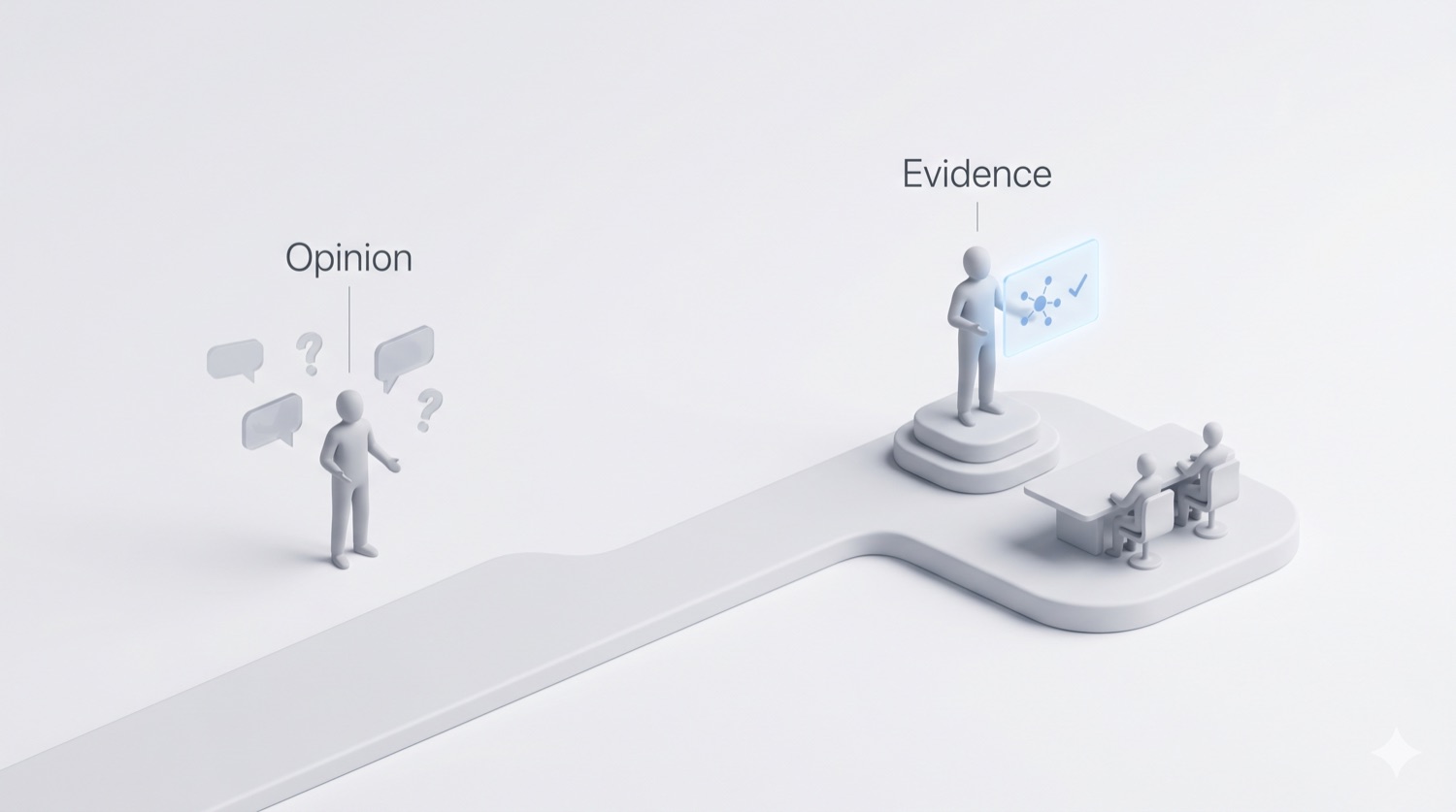
You were hired for your judgment. Then you walked into a codebase you didn't build, a team you met last week, and a CEO who wants a plan by Friday. The one thing you're paid to deliver — a read the room can act on — is the one thing you don't yet have the evidence to back.
This is the fractional CTO's bind, and it is structurally different from the one a full-time CTO faces. A full-time hire earns trust over quarters. They sit in the stand-ups, absorb the history, watch a release cycle or two, and by the time the board asks a hard question they have months of context behind their answer.
You don't get quarters. You get weeks. You were brought in precisely because someone needed senior technical judgment fast — a CEO without a CTO, a board between leaders, a founder who has outgrown their own read on the stack. The mandate is urgent by definition. And on day one, you have the least context of anyone in the building and the highest expectations.
The credibility gap
Here is the uncomfortable part. The team that built the system has the context. You have the authority. The two don't overlap yet, and everyone in the room knows it.
So when you say "the architecture won't scale" or "this roadmap is at risk" or "we're carrying too much debt to ship that in Q3," you are asking people to trust your pattern-matching. Sometimes that's enough. You have seen forty systems; this is the forty-first; the shape is familiar. But "trust me, I've seen this before" is the weakest possible footing in a board conversation, an investment decision, or a fight with a founder who is emotionally attached to the system you're critiquing.
The team can wave you off as the outsider who doesn't understand why things are the way they are. The board can quietly discount you as expensive insurance. And you can be completely right and still lose the argument, because judgment without evidence reads as opinion — and the room is drowning in opinion already.
Opinion doesn't survive the room
The questions a fractional or interim CTO gets pulled in to answer are not soft ones:
- Can we actually ship the roadmap the board was promised?
- Is the engineering spend producing what the plan assumed?
- What breaks if the one engineer who understands billing leaves?
- Why hasn't the AI investment created value yet?
- Do we have the team for the next twelve months, or do we hire, partner, or scope down?
Every one of these is a decision with money and careers attached. And your answer is only ever as strong as what sits underneath it. Underneath most fractional reads is the same thing: a week of interviews, a skim of the repo, and the internal team's version of the story. That is enough to form a hypothesis. It is not enough to sign your name to a recommendation the CEO is going to act on.
What you actually need
An evidence layer underneath your judgment — before Friday, and in your voice. Not the team's version. Not the previous CTO's version. The version the systems themselves can defend.
That is exactly what the Founders Led Studio advisor partner program is built to give you: an independent, code-level read you carry into the room under your own name, with us invisible behind it if that's what the relationship needs.
The systems already wrote it down
Here is the thing the listening tour misses: the truth is already recorded. It just isn't in the wiki, and it isn't in anyone's head in one piece.
It's in the build-and-operate record — the code, the commit history, the tickets, the roadmaps, the ownership patterns, the deploy and incident logs. That record doesn't have a stake in the meeting. It doesn't remember the politics. It shows what the organization actually decided, shipped, and neglected, independent of whose version you happened to hear first.
Read it properly and the fog clears fast. Who really owns the critical paths, and what happens when they leave. Where the architecture has drifted from the story everyone tells about it. How much of the team's week goes to keeping the lights on versus building the future. Whether the AI that's in the budget is actually wired into anything. This is the same read we produce for an incoming full-time leader trying to answer "what did I inherit?" — compressed to the clock a fractional engagement runs on.
You don't have ninety days
The standard advice for a new technology leader is to spend the first ninety days listening before acting. It's good advice for someone with ninety days. You are often expected to have a point of view by the end of week two.
That compression is why a fractional CTO can't run the read the way a full-timer would — slowly, by osmosis, over a quarter of stand-ups. You need the baseline in weeks, not months, and you need it without pulling the engineering team off the work you're there to accelerate. A read-only engagement that connects to the systems, takes three weeks, and requires no engineering meetings fits the shape of the problem. The team keeps shipping. You get the evidence. Nobody loses a sprint to it.
"The strongest fractional CTOs don't walk in with answers. They walk in with the right questions and an independent way to prove the answers — fast."
You stay in front. The evidence stays behind you.
None of this is about replacing your judgment. The judgment is what the client is paying for, and it is yours. The read is the thing that makes the judgment defensible — the layer that turns "I think" into "here's the evidence, and here's what I'd do about it."
That's the whole logic of the partner model. You hold the relationship. You frame the questions that matter to your client's moment. You hand over the brief and you answer the room. We stay behind the read, white-label or co-branded, on the timeline your engagement runs on. The brief speaks in your voice, under your name, and the live layer stays connected for the next hard question the board lands.
The next time a CEO asks for a plan by Friday, you can give them one they — and you — can defend. Not because you've been there longer. Because you brought the evidence.