For PE operating partners & value-creation teams

"Are we on the roadmap the board approved?"

Independent codebase intelligence for portfolio operating reviews, 100-day plans and value-creation tracking. A continuous read across the company's stack — code, commits, tickets, roadmaps, ownership, data. It surfaces drift between what was approved and what was built — before the quarterly LP update.

Get a Read → Two weeks · Fixed price · Read-only · No portfolio-team meetings

One conversation. No pitch deck. We'll tell you if we can't help.

Why now

The CTO says we're on track. The code says otherwise.

Portfolio operating reviews run on the CTO's narrative. The board approved a value-creation plan twelve months ago, the CTO sends a quarterly update, and the operating partner has no independent way to test whether the two match. The questions that drive the next investment, the next add-on, the next exit reset depend on knowing the actual state of the platform — not the version the CEO and CTO want to present.

Each of these is a value-creation question with deal-math consequences. Independent codebase intelligence answers them on the portfolio-review clock.

What the read covers

Six dimensions of the operating reality.

01

Decision Archaeology

The discipline behind the read. Code, commits, tickets, PRDs, roadmaps, ownership, tests and data — correlated together, over time. The output is the sequence of decisions that shaped the platform since acquisition.

02

Roadmap Drift & Value-Creation Tracking

What the board approved at acquisition versus what was actually built since. Quarterly drift surfaced before the LP update. Capability alignment gaps mapped to the value-creation plan.

03

Tech Debt Trajectory

Technical debt quantification by domain, in dollars and quarters. The velocity tax the operating model is paying. Not "high" or "moderate" — a defensible number that goes into the next investment case.

04

Knowledge Concentration & Retention Risk

Who actually maintains the critical systems, by commit — not by org chart. Where the hero problem lives. Key person risk and the cost of losing them after the earn-out ends.

05

AI Footprint & Portfolio Compliance

Which models run where, on what data, making which decisions. EU AI Act exposure, board-reporting readiness, and the AI integrations the CEO didn't mention in the last update.

06

Architecture Scalability for the Thesis

Can the platform support the value-creation thesis? The growth case, the add-on integration, the exit profile. Surfaced from the code, not from a roadmap slide.

What you keep

The signed read. Plus the continuous intelligence layer.

The signed read is what your investment committee, your LPs and your operating partners act on. The continuous intelligence layer stays live across the portfolio company's stack — in their reporting, in the developers' IDEs, in the PM tools, via MCP to whichever LLM they already use — so the next operating review doesn't require another engagement.

Buy-side diligence

Independent code-level read of the target before close. Cost surprises surfaced, mapped to domains. Designed for deal timelines and data-room confidentiality.

100-day plan grounding

The read becomes the foundation for the first 100 days post-close. Risks mapped to retention, modernization and integration priorities.

Quarterly operating reviews

Roadmap drift, tech debt trajectory and capability alignment — updated continuously, surfaced before the quarterly LP update, not after.

Exit readiness

A defensible read for the exit narrative. Platform scalability, AI footprint, IP and licensing exposure — ready for the buy-side before the bankers ask.

Before & after the read

The operating-partner view, sharpened.

Before

  • You're reading the CTO's quarterly update. It's optimistic.
  • Roadmap drift surfaces during the quarterly review, not before.
  • Tech debt is described in adjectives. You can't price it.
  • Key person risk is something you suspect but can't quantify.
  • AI footprint is whatever the CTO has remembered to mention.
  • The exit pitch starts with "let me explain the platform…"

After

  • You have an independent, source-traced read of the same period.
  • Drift is surfaced before the review, mapped to the value-creation plan.
  • Tech debt is quantified in dollars and quarters, by domain.
  • Key person risk is mapped: who, what breaks, what it costs to mitigate.
  • AI footprint is documented: every model, every data path, every decision.
  • The exit pitch starts with the signed read.
Timeline

Two weeks. Built for the operating clock.

Week 0 · Connect

Read-only access

NDA execution, read-only access to the portfolio company's codebase, commits, tickets, roadmaps and ownership signals. One 30-minute call. No disruption to the operating team.

Week 1 · Read

Precision, correlation, business decomposition

Deterministic static analysis surfaces what's there. Multi-source temporal correlation ties it together since acquisition. Every finding maps to the value-creation plan domains.

Week 2 · Deliver

Signed read + intelligence layer

The signed Five Stories for your investment committee. The continuous intelligence layer live in the portfolio company's stack, ready for the next operating review without another engagement.

Operating-partner questions, answered

What the board approved vs. what's being built.
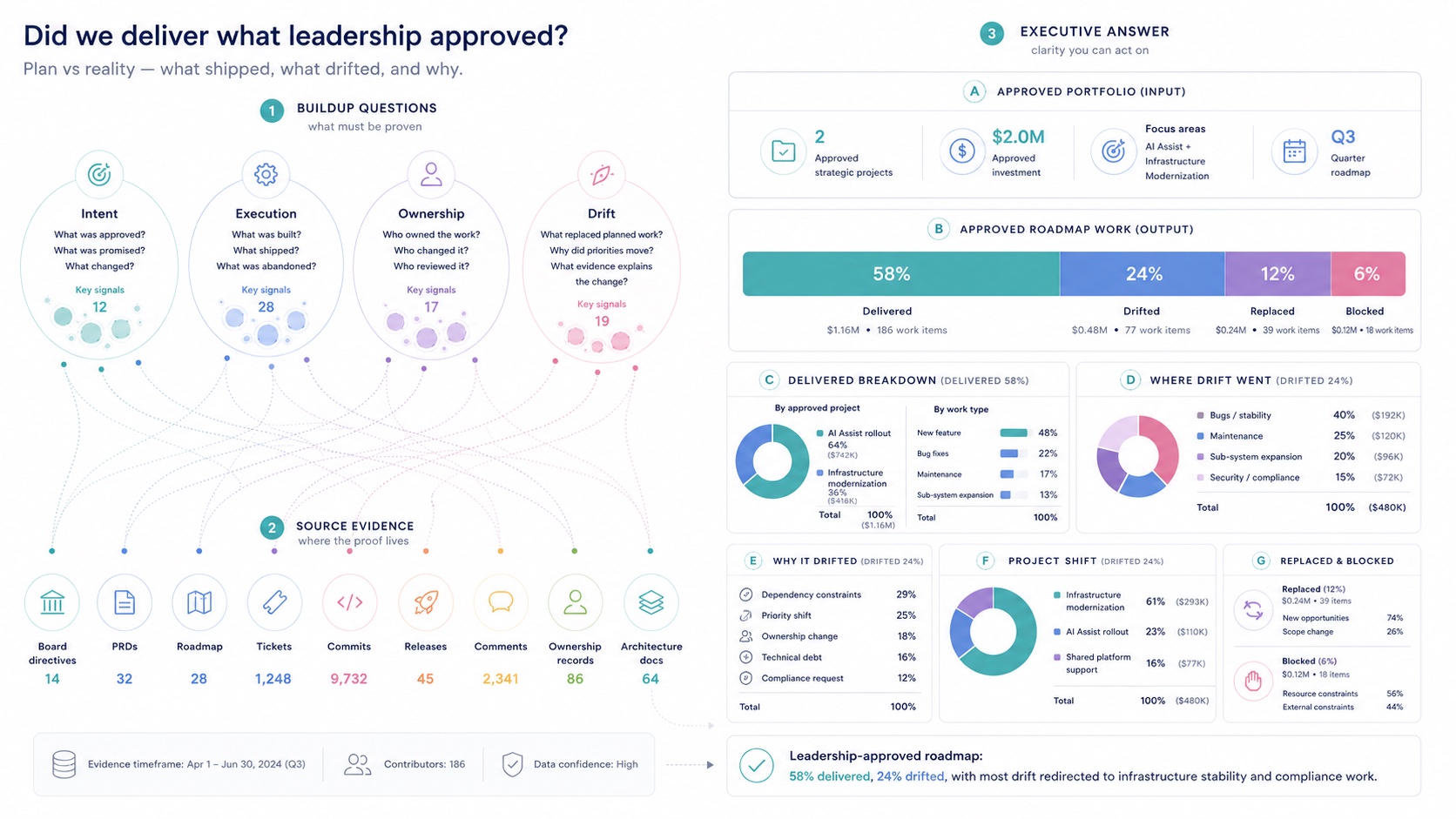
Why does the engineering team keep missing the roadmap?

Usually because the roadmap the board approved and the work actually happening have quietly drifted apart — time is going to unplanned maintenance, hidden blockers, and rework nobody surfaced. We measure delivery predictability by comparing the approved plan against what the commits and tickets show was really built, so the gap is visible before the quarterly review, not after another missed quarter.

What is the engineering team actually working on?

We map where engineering effort actually goes — roadmap features versus maintenance, rework, and firefighting nobody chose — from the commit and ticket record rather than a status deck. For an operating partner, that's the difference between "we're on track" and a defensible read of where the budget is being spent and what it's buying.

Where is value being created — or destroyed — in the product?

Post-acquisition value creation depends on directing engineering investment to the domains that drive returns and away from the ones quietly consuming it. We surface where complexity, debt, and key-person risk concentrate by business domain, so capital-allocation decisions across a portfolio company rest on what the code shows, not on the management team's account of itself.

Which engineering metrics actually matter to the board?

Not lines of code or story points. The ones that survive a board conversation are roadmap drift, technical debt quantified in dollars and time by domain, key-person concentration on revenue-critical systems, and AI footprint. We deliver those as evidence traceable to the commit — the metrics that map to value and risk, not to engineering vanity.

What we lead with

We lead with the read. Independent. Defensible. Yours. We deliver the map. Whether we ride along comes next.

What you do with the read is your call. If you want a partner on integration, modernization or what to build next — that's a different conversation, and we can have it. The independence of the read stays intact regardless — which is exactly why your LPs can rely on it.

Walk into the next operating review with a read.

Two weeks. Fixed price. Read-only. No meetings with the portfolio operating team. One conversation to start — we'll tell you if we can't help.

Get a Read

Other moments we read for